
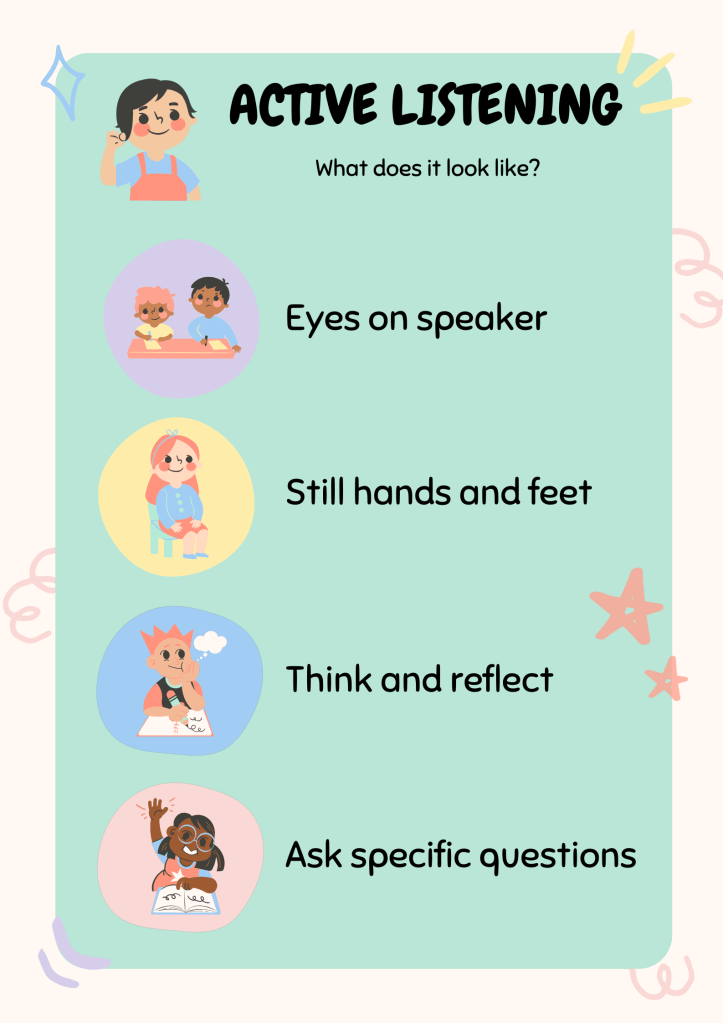
Active listening means deeply engaged in and attentive to what the speaker is saying. It requires far more listening than talking. Your goal as an active listener is to truly understand the speaker’s perspective (regardless of whether you agree) and to communicate that understanding back to the speaker so that they can confirm the accuracy of your understanding.
–Paraphrasing – Restate the same information, using different words to concisely what the speaker said. It tests your understand of what is heard by communicating your understanding of what the speaker said. It allows the speaker to ‘hear’ and focus on his or her own thoughts. Allows the speaker to see that you are trying to understand they’re message and perceptions. It also encourages the speaker to continue speaking.
–Clarifying – Invite the speaker to explain somaspect of what is said. It allows the speaker the opportunity to elaborate and clarify what is said. It also gives the opportunity to identify anything that is unclear and to check the accuracy of your understanding.
–Reflecting – Relaying what is said back to the speaker to show that you understand how they feel about something. It deepens the understanding of feelings and content. It allows the speaker to see that you are trying to understand his/her messages and perceptions.
–Summarizing – Identify, connect, and integrate key ideas and feelings in what the speaker said. It helps both lister and speaker identify what is most important to the speaker.
Roadblocks To Good Listening
–Fixing – Ordering, suggesting, advising, dianosing
–Evaluating – Judging, threatening, praising, condemning, taking sides, giving opinions
–Diverting – Reassuring, changing the subject, focusing on your own agenda, minimizing
–Interrupting – Interjecting comments, not allowing speakers own pace, tuning out, creating/responding to distractions, cross examining
Tips For Active Listening
-Listen more than you talk
-Let the speaker finish before you respond
-Ask open-ended questions
-Remain attentive to what’s being said
– Be aware of your own biases
-Manage your own emotions
-Be attentive to ideas and problem solving opportunities
-Give verbal and nonverbal messages that you are listening
-Listen for both feelings and content
 Mental Stregnth For Life
Leave a comment